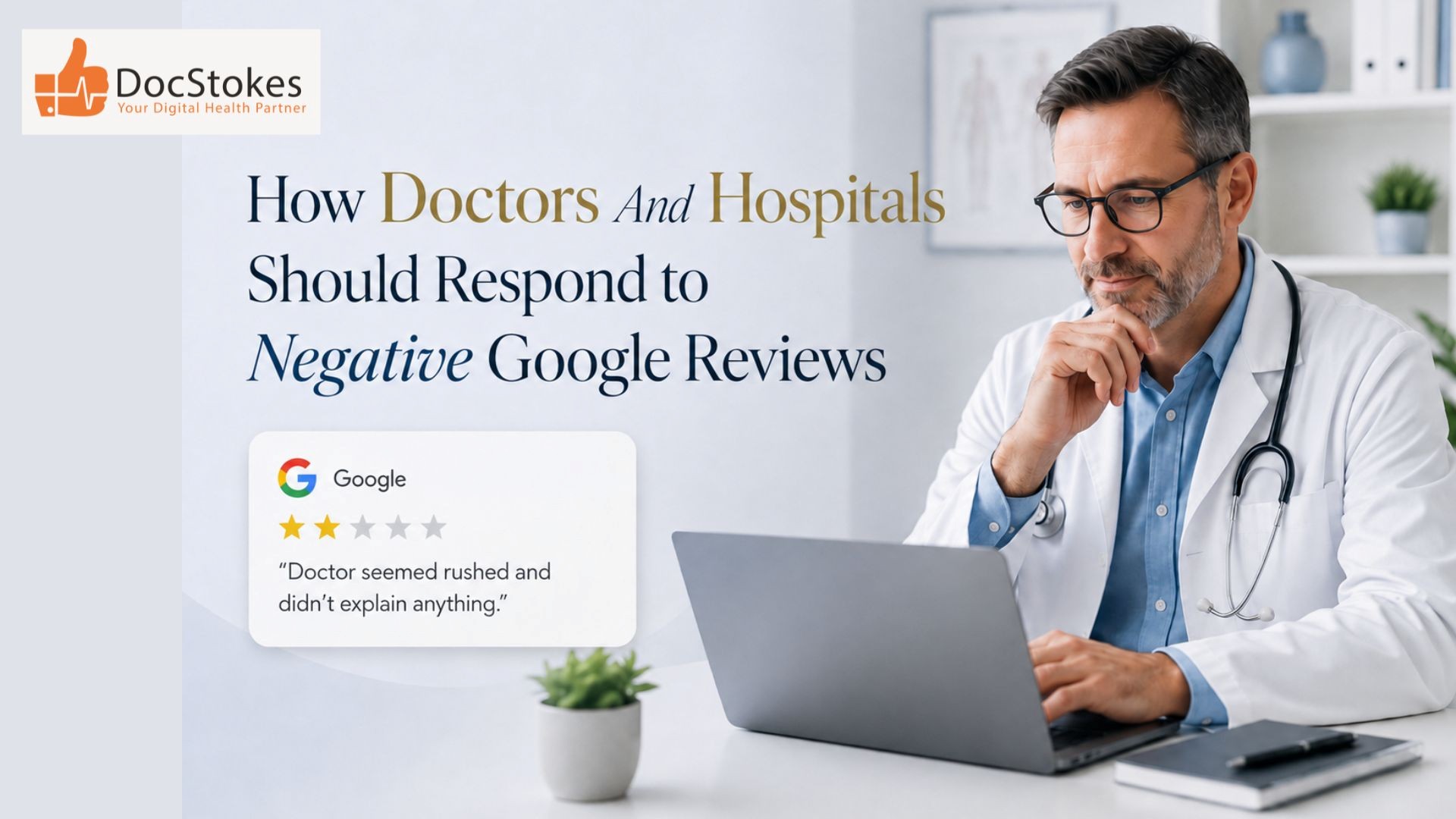
Being a doctor or a hospital superintendent, have you also experienced that one day a patient leaves your clinic or hospital after a 20-minute wait because of x or y reason which was not under your control, and that evening, they open Google and leave a two-star review? "Doctor seemed rushed and didn't explain anything." By morning, three prospective patients in your city have read it and quietly picked someone else. In today’s world of digital marketing for hospitals in India, this scenario is a reality healthcare providers can no longer ignore. Your Google Business Profile is not a formality. For many patients, it is the first and the most decisive thing they check before booking.
The question is not whether you will get a negative review. You will. The question is what you do next.
Why Your Reply Is Read by Hundreds, Not Just One
Most doctors think a review reply is a conversation with the person who complained. It is not. Your reply is a public statement read by every future patient who finds your profile on Google Search. A 2023 BrightLocal study found that 89% of patients read business responses to reviews before making a decision.When you reply well, silent readers see a doctor who is accountable and professional. When you stay quiet or reply defensively, they see a red flag. At DocStokes, our experience as an SEO agency for hospitals in India has shown us that each reply should be treated as content; it signals to Google and to patients what kind of practice you run.
What Exactly Are You Allowed to Say in a Public Google Reply as a Hospital or a Doctor?
Under NMC guidelines and India's Digital Personal Data Protection Act 2023, you cannot confirm that the reviewer was your patient in a public reply, even if they have described the visit in detail.The moment you write "We're sorry about your experience during your visit on Tuesday" or "Our diagnosis was correct based on the reports you brought," you have publicly confirmed a doctor-patient relationship without written consent. That is an ethics violation, and it can be used against you legally.Your reply must stay generic and process-focused, regardless of how specific the complaint is.What this looks like in practice:Wrong: "We understand you were unhappy with the wait time during your cardiac consultation."Right: "We take all feedback about our patient experience seriously. We would welcome the chance to speak with you directly; please call us at [number]."
A Step-by-Step Response Framework
Here is a clean four-step approach that works for most negative reviews:
● Acknowledge the experience without confirming any clinical detail
● Apologise for how they felt, not for the medical care
● Invite them offline with a direct phone number or email
● Close with a sentence that signals your standard of care to future readers
A reply under 80 words works better than a long explanation. Patients and Google both prefer concise, direct responses.
What AI Search Sees When You Reply
Google, Gemini and Perplexity now read your Google Business Profile as a trust signal. A profile with unanswered one-star reviews is treated differently in local search rankings than one where the doctor responds consistently and professionally.
A good social media marketing agency for hospitals in India will tell you: review responses are micro-content. They contribute to your local SEO, they signal activity to Google's algorithm, and they show up in AI-generated summaries of your clinic when patients ask "Is Dr. [Name] good?" on ChatGPT or Perplexity.
Consistency matters more than perfection. Replying to 90% of reviews, even briefly, outperforms a clinic that replies to none.
Should You Flag or Report a Review?
Yes, but only in specific situations. Google allows you to flag a review for removal if it contains:
● Fake content from someone who was never a patient
● A personal attack or hate speech
● Content from a competitor or a disgruntled former employee
● Spam or off-topic material
The process:
Go to your Google Business Profile
Find the review, click the three-dot menu and select "Report review".
Google takes 5–14 days to assess it.
Document everything before you flag; screenshot the review with the date visible.
Do not ask patients, verbally or in writing, to change or delete their review. That can create unnecessary compliance and reputation risks. At DocStokes, as a responsible digital marketing agency for doctors in India, we recommend handling review flagging only through the correct Google channels and following up through the appropriate process if no action is taken.
Mistakes to Avoid While Responding To Google Reviews
● Replying within the first hour when you are angry; wait at least 24 hours
● Naming the treatment, medication or diagnosis in your response
● Asking a staff member to reply without a review protocol in place
● Posting fake positive reviews to bury negative ones; Google's algorithm detects these
● Ignoring reviews entirely and assuming patients won't notice
When hospitals are searching for the best digital marketing company for hospitals in India , it should not be just about rankings, traffic or lead generation. And reputation management is important too. A sound healthcare marketing strategy must include regular monitoring and review, clear response guidelines, escalation protocols for sensitive complaints and a consistent tone that protects both patient trust and the hospital's professional credibility.
It’s also important to look back at how your team handled situations in the past. In fact, a slow response, a defensive tone, a copied reply, or a comment that gives away too much patient information can create more risk to your reputation than the original review. A good audit helps to identify these gaps and draws up a response framework which is professional, compliant and practical to follow by the hospital team.
At DocStokes we take care of review monitoring, response protocols and reputation recovery for hospitals and clinics across India. Inconsistencies in your Google profile, or a lack of a reply, can be identified through an audit and can help you to understand where the problem lies and what needs to be changed.
Likewise, when selecting the best digital marketing company for doctors in India, doctors must pick a team that knows the difference between regular brand marketing and healthcare communication where patient privacy, medical ethics and professional reputation are to be kept top of mind in every response.
FAQ
Can a doctor legally respond to a Google review in India?
Yes. NMC guidelines do not prohibit responding to reviews. They require that your response never confirms a doctor-patient relationship, never discloses clinical details, and remains professional. Staying generic and inviting offline resolution is both legally safe and ethically correct.
What if the Google review is completely false?
Flag it through Google Business Profile for removal. While Google reviews the request, publish a calm, generic reply that does not engage with the false claims; this shows future patients you are responsive. Keep screenshots as documentation in case you need to escalate.
Should my receptionist reply to reviews, or should I?
Either can work; what matters is that a written protocol exists. Responses must never come from memory or emotion. A standard reply template, reviewed by someone familiar with NMC guidelines, protects you better than an improvised response from anyone on your team.
How many reviews do I need before my Google rating stabilises?
As a general pattern, clinics with over 50 reviews tend to see their average rating stabilise. One bad review has far less impact at 80 reviews than it does at 12. Actively and ethically encouraging satisfied patients to leave reviews is the most reliable way to protect your rating long-term.
